Tech Giants Envision Future Beyond Smartphones
For more than a decade, smartphones have been at the center of the global technology ecosystem. They reshaped communication, commerce, entertainment, and even personal identity. However, as innovation in smartphone hardware slows and markets reach saturation, the world’s leading technology companies are increasingly looking beyond the rectangular glass slab. Tech giants are now envisioning a future where smartphones are no longer the primary gateway to the digital world, replaced or complemented by a new generation of intelligent, immersive, and interconnected technologies.
The Limits of the Smartphone Era
The smartphone revolution has matured. Annual upgrades now offer incremental improvements rather than transformative change. Faster processors, better cameras, and brighter screens still matter, but they no longer excite consumers the way early smartphones once did. In many regions, smartphone penetration is near its peak, and replacement cycles are getting longer.
For tech giants whose business models rely on growth, this presents a challenge. Companies like Apple, Google, Meta, Microsoft, and Amazon recognize that the next wave of innovation must extend beyond smartphones to sustain momentum. This realization is driving massive investments into emerging technologies that aim to redefine how humans interact with digital information.
Wearables as the Next Computing Layer
One of the most immediate steps beyond smartphones is the rise of advanced wearables. Smartwatches, fitness trackers, and wireless earbuds have already become mainstream, but companies now see them as more than accessories. Instead, they are evolving into independent computing platforms.
Smart glasses, in particular, are gaining renewed attention. Unlike earlier failed attempts, modern smart glasses are being designed with better hardware, improved aesthetics, and more practical use cases. By overlaying digital information onto the physical world, these devices promise hands-free navigation, real-time translations, contextual notifications, and seamless access to AI assistants.
Tech giants envision a future where wearables quietly handle many tasks currently done on smartphones, reducing screen dependency and enabling more natural interactions with technology.
The Rise of Spatial Computing and Extended Reality
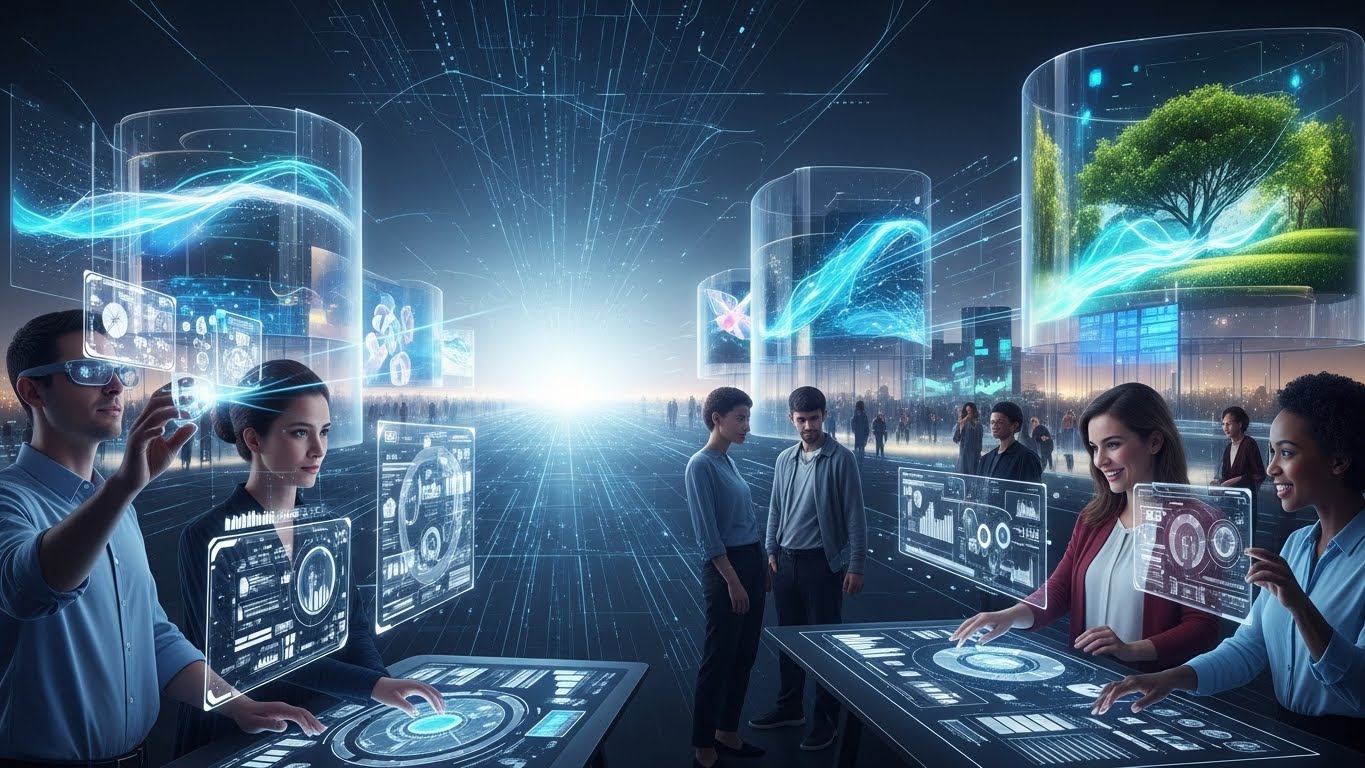
Another major frontier lies in spatial computing, a concept that blends the physical and digital worlds through augmented reality (AR), virtual reality (VR), and mixed reality (MR). Instead of interacting with apps through a small screen, users could engage with digital content as if it exists in their surrounding environment.
Virtual reality is already transforming gaming, training, and remote collaboration. Augmented reality, on the other hand, holds broader everyday potential—from visualizing furniture in a living room to assisting technicians with complex repairs. Mixed reality aims to combine the best of both, allowing digital objects to interact convincingly with the real world.
Tech giants see extended reality as a long-term replacement for smartphones, offering a more immersive, intuitive, and powerful way to compute. While challenges remain—such as comfort, battery life, and affordability—ongoing advances suggest that spatial computing could become a central pillar of future digital life.
Artificial Intelligence as the Invisible Interface
Artificial intelligence is perhaps the most transformative force shaping the post-smartphone future. Rather than relying on touchscreens and apps, tech companies are building AI-driven systems that understand voice, context, and intent.
AI assistants are evolving from simple voice commands into proactive digital companions. These systems can anticipate needs, manage schedules, filter information, and provide real-time insights without requiring constant user input. In this vision, technology fades into the background, becoming an invisible layer that supports daily life.
Large language models, computer vision, and real-time data processing allow AI to act as the primary interface between humans and machines. This shift reduces reliance on smartphones as control hubs, distributing intelligence across multiple devices and environments.
The Internet of Things and Ambient Computing
Beyond personal devices, tech giants are investing heavily in ambient computing—an environment where technology is embedded seamlessly into everyday spaces. Smart homes, connected cars, and intelligent workplaces are all part of this vision.
In an ambient computing world, lights adjust automatically, appliances respond to habits, and vehicles communicate with infrastructure to improve safety and efficiency. Instead of pulling out a smartphone to control everything, interactions become contextual and automatic.
This approach relies on the Internet of Things (IoT), where billions of connected devices share data and respond intelligently. Smartphones may still exist, but they will no longer be the central command center. Instead, they will act as one node in a much larger, interconnected ecosystem.
Brain-Computer Interfaces and Human Augmentation
Looking further into the future, some tech leaders are exploring even more radical ideas, such as brain-computer interfaces (BCIs). These technologies aim to create direct communication pathways between the human brain and computers.
While still experimental, BCIs could eventually allow users to control devices, communicate, or access information using thought alone. Such developments could dramatically reduce the need for physical interfaces like screens or keyboards.
Human augmentation technologies, including neural implants and advanced prosthetics, also suggest a future where digital interaction is deeply integrated with the human body. Though ethical and technical challenges are significant, tech giants see long-term potential in redefining the boundaries between humans and machines.
Economic and Social Implications
The move beyond smartphones will have far-reaching implications. Entire industries built around mobile apps, accessories, and hardware may need to adapt or reinvent themselves. Developers will have to design experiences for voice, gesture, and immersive environments rather than touchscreens.
There are also important social considerations. Reduced screen time could improve mental health and attention, but increased data collection and AI-driven environments raise concerns about privacy, surveillance, and control. Tech giants will need to balance innovation with responsibility to gain public trust.
Additionally, the digital divide may widen if advanced technologies remain expensive or inaccessible. Ensuring that future digital frontiers benefit a broad population will be a critical challenge.
A Gradual Transition, Not an Overnight Shift
Despite ambitious visions, smartphones are unlikely to disappear anytime soon. Instead, tech giants anticipate a gradual transition where smartphones coexist with new devices and interfaces. Over time, as alternative technologies become more capable and convenient, reliance on smartphones may diminish naturally.
This transition mirrors past shifts in technology. Just as desktops gave way to laptops and then smartphones, the next evolution will build upon what came before rather than replacing it instantly.
Conclusion
Tech giants envision a future beyond smartphones that is more immersive, intelligent, and seamlessly integrated into everyday life. Through wearables, spatial computing, artificial intelligence, ambient environments, and even brain-computer interfaces, the digital experience is set to become less about screens and more about presence, context, and intuition.
As these new digital frontiers emerge, they promise to redefine how humans interact with technology, each other, and the world around them. While challenges remain, one thing is clear: the era of the smartphone as the sole center of digital life is slowly giving way to a far broader and more ambitious technological horizon.
About the Author